Wednesday, 14 January 2015

Making a Tudor shirt, part three - collar and cuffs

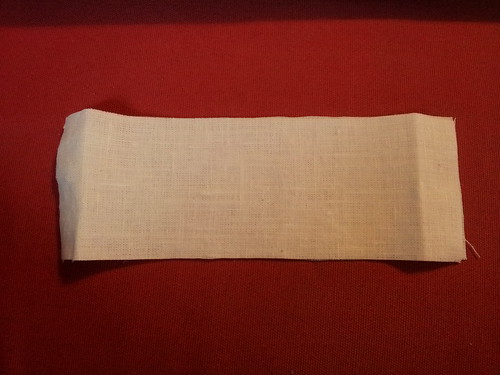
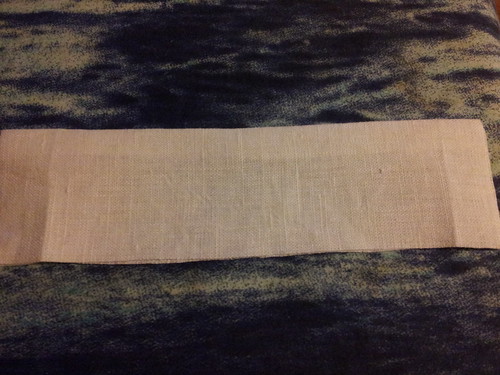
The collar and cuffs are assembled in exactly the same way, so I find it easiest to do them all at the same time.

First, make sure you've finished any embroidery you want to put on.

Next, press the pieces. You want the edges to be perfectly straight, and it's MUCH easier if the fabric has been pressed first. If you've added embroidery, press it on a towel with the right side facing downwards. Cotton can be pressed at the same high temperature as the linen fabric, but if you're using silk you should turn the heat down when you're pressing over the embroidery.

Next, pair up the pieces of fabric. The right side of the embroidery should be in between the two pieces of fabric, because once you've sewn the first seam you'll be turning it over.

At this point you can pin the two pieces of fabric together so that they stay in line. I do for the collar because it's so long, but don't bother for the cuffs. Up to you.

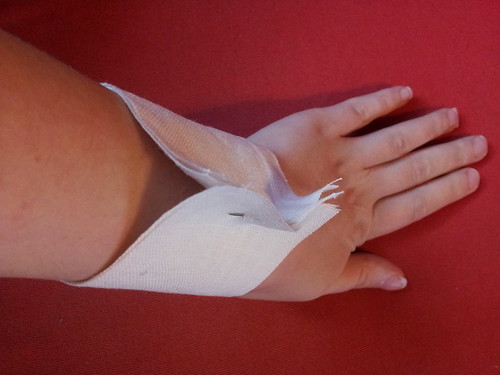
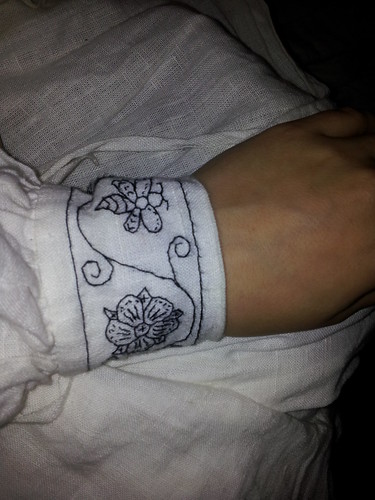
Next you'll need to do a little measuring. Take your first cuff (both pieces) and wrap it around your wrist so that the excess fabric of the seam allowance is divided evenly on both ends:

You don't need to pin anything at this point - I've pinned the ends together because I can't hold a loop shut and take a photo at the same time.


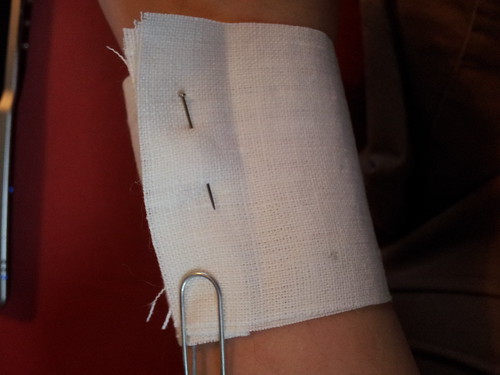
Fold the excess fabric first to one side and then the other, keeping the loop pinched tight against your wrist. Use your fingers to press hard on this fold and create a crease.

Same deal with the paperclip - it's a photography aid, not an instruction.


Unwrap the cuff from your wrist. You now have a cuff with a vertical crease at either end. The creases mark the finished circumference of the cuff.


The next step is to sew the two pieces together. If your cuffs are embroidered, you are going to sew them together at the edge you want to be closest to your hand!

We're sewing the seam on the side of the cuff where my hand is.


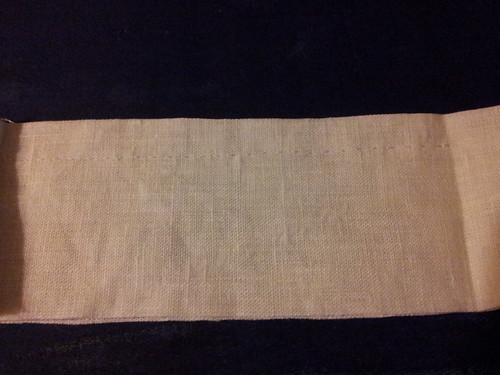
Using running stitch, sew in a straight line from one crease to the other about half an inch in from the long edge.


For the second cuff, you can skip wrapping it around your wrist and pinching - just use the vertical creases from the first cuff as a template. Sew the second cuff's seam in the same manner.

At this point, you're done with the sewing, but there's still a fair bit of pressing to do. First, press open the seam you've just made.


Next, turn the cuff so that the seam allowances are on the inside and press it flat along the fold.


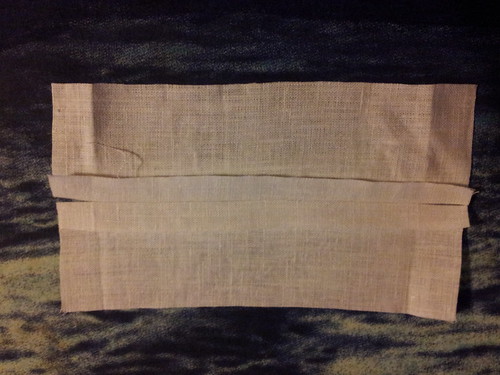
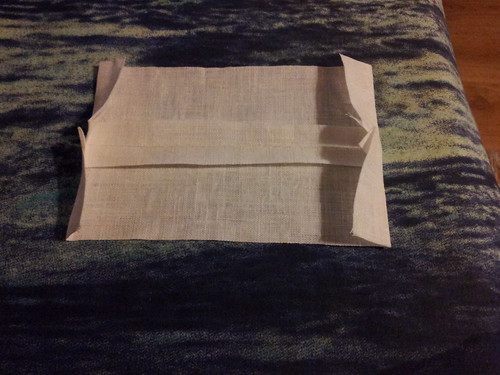
Next, open it back up and lay it flat with the right side facing down into the ironing board. Fold the short ends of the cuffs in, along the creases that you folded in earlier.


Close the cuff back up and press along the short sides and at the top corners. There's a lot of fabric folded up here, so be careful that your corners remain square.

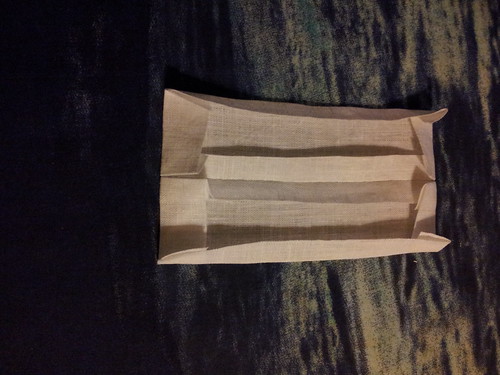
Next, open it up yet again and fold half an inch of each of the long open edges in.


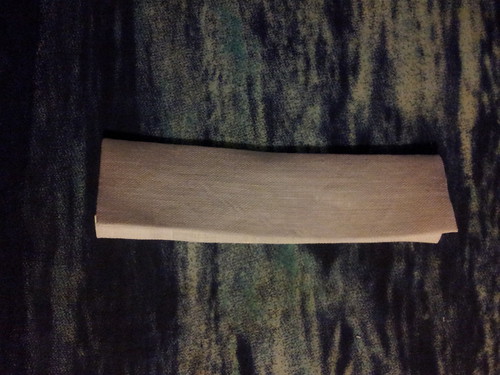
Finally, close the cuff back up and give it one last good press, paying special attention to the corners.


Press the second cuff, and then assemble and press the collar.


You won't do anything else with the collar and cuffs until it's time to attach them to the shirt body and sleeves respectively, so put them somewhere safe so that they won't get crumpled (but not so safe you can't find them).

Making a Tudor shirt, part two - planning the embroidery

It's much easier to add any embroidery to the shirt before you start assembling the pieces, so the next task is to decide which bits to embroider. Because my shirt is going to be a working shirt, I'm not adding any embroidery, but you might want to.

When worn, the only parts of the shirt that are visible are the collar and cuffs. (See, for example, this painting.) If you do want some embroidery, then, those are the parts that should definitely be embroidered. However, for something truly sumptuous, there are other places to add embroidery. These are:
  • The sleeves (either in columns or in an allover arrangement)
  • Around the neck slit on the front of the shirt
  • Across the upper torso, both in the front and in the back 
  • All the way around the rectangle of the body piece, close to the hem or seam
  • Occasionally, directly on top of any seams, especially on pieces with shoulder seams
As with the shirt of insanity, you can also work blanket stitching around hemmed pieces and lace them together. You can also hem the pieces and work direct insertion stitches, as was done in the example photo in part one of this tutorial. I'm going to be working plain seams, though, as they are simpler and less likely to catch on things.

The style of embroidery changes dramatically during the 16th century. Pieces from the 1530s and 1540s are very strongly geometric, with densely-stitched patterns that create a voided effect. By the end of the century, however, embroidery has become much more representative: plants and animals are clearly identifiable.

Tuesday, 13 January 2015

Making a Tudor Shirt, part 1 - the fabric

A few people have expressed interest in parts of the process of making one of these Tudor shirts, so since I'm making another one at the moment, I thought I'd write it up as a series of tutorials. For the purposes of this series I'll be talking about men's shirts (as that's what I'm making), but in practice there is very little difference between men's shirts and women's shifts. Generally women's were longer, but not necessarily; indeed, some of the extant men's shirts were long enough to perform duty as a modern maxi-dress!

The first thing to do is select fabric for the shirt. Thus far, all the surviving shirts I've seen have been linen. It's perfect to wear close to the body and it holds up to wear very well, so if at all possible go with linen. The drape and thread count varies depending on the purpose of the shirt. Shirts for boys were generally of finer material than shirts for grown men, and the fancier the shirt, the finer the linen was likely to be.

This:


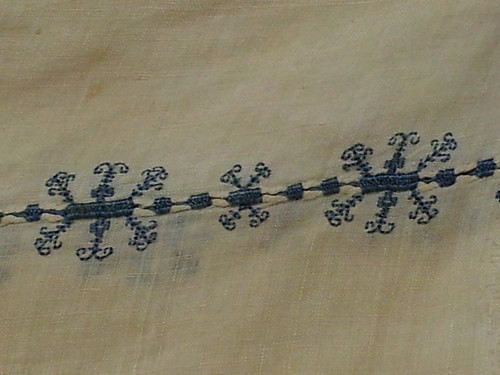
is a detail from a shirt in the V&A dated c. 1540. The fabric is so fine you can see the embroidery on the back through the front.

My shirt, however, is going to be a much sturdier piece. I'm making it to wear while I'm shooting, so I don't want to have to worry about catching it on a hedgerow while I'm hunting for arrows and ripping it. I'm not embroidering it, either, because I expect to have to wash it more frequently than my other SCA clothing.

The amount of fabric will vary depending on how big a shirt you want. (No, really, Captain Obvious?) You'll need the following pieces:
  • The body (a single long rectangle)
  • 2 sleeves (rectangles)
  • 2 underarm gussets (squares)
  • 1 each of collar front and back (rectangles)
  • 2 each of cuff front and back (rectangles)

The front of the shirt should be from the top of the shoulder to just above the knee, and the back should be a couple of inches longer. Ideally you'd have this as a single length of fabric (most of the extant shirts are), but it's still correct to have shoulder seams and two separate pieces.

I've cut mine so that the width of the fabric twice (for the front and the back) is about 10 inches bigger than my widest measurement. Too baggy is better than too tight - too tight will rip when you try and take it on and off.

The sleeves should be the same length as your arm from the wrist to the shoulder. You'll get extra length from the cuff and the excess width of the body fabric at the shoulders, which will create the poofy effect on the finished sleeves. I've been cutting the sleeves about 18 inches wide - it seems to create a comfortable fit for the various adults who have tried it on.

The underarm gussets on the shirts I've made so far are about 5-and-a-half inches. I'm rather well endowed, so had expected I'd need bigger gussets, but actually they are plenty roomy and allow more than enough movement to shoot in.

The finished cuffs should be exactly the circumference of the wrists, and the collar exactly the circumference of the neck. A little gap at the front of the collar is ok, but I've not seen any portraits with overlapping collars. For each cuff and for the collar you'll need two identical rectangles of fabric about 2.5 inches wide and as long as your body measurements require. The 2.5 inches includes seam allowance - don't forget to add seam allowances to the total length, too!

The only pieces of the shirt that need to fit precisely are the collar and cuffs. Everything else is meant to be baggy, so if your fabric is a little wider, there's no reason not to use the full width.


Wednesday, 7 January 2015

Let the Year of Selfish begin!

Happy New Year, everyone! It is officially the start of the Year of Selfish craft-along.

There are no deadlines and just one rule - have fun making stuff for yourself. If that means making things to sell to fund your other escapades, great. If it means working on reducing your stash, or working through your works-in-progress, awesome. If it means starting all those things you've been putting off forever, go for it.

Personally, I'm going to be working a little bit on all of those things. My enormous list of goals is going to take somewhere in the region of 3-4 years, but here are some highlights:

  • A complete outfit, c. 1545, for shooting in
  • Finally finishing my Yule Shawl (started more than two years ago!)
  • Knitting a shawl for a friend's wedding, from fancy stash I bought and have been hoarding
  • Restocking my sock drawer
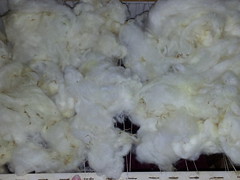
  • Washing and spinning up some of my fleeces
  • Making a quilt
Basically, I want to have a year balanced equally between finishing stuff in progress and new projects, while reducing the overall volume of my stash.

Wednesday, 31 December 2014

Sheep are disgusting.

(Normal people spend New Year's Eve washing fleece, right?)

The thing about sheep is, they're animals. They eat, they poo, they sweat, they step in stuff, they roll in stuff. When the fleece comes off it's pretty gross and needs to be washed before anyone plays with it.

There are a million ways to get the crap out of a fleece, both literally and figuratively. The two main schools are hot-water-and-dish-soap and fermented suint. Since I live in 3rd-floor apartment in central London, I generally use the former. Fill the bath with hot water and Fairy Liquid, swish around, drain, rewash if the water's really gross, then rinse and air-dry. I think my neighbours might complain if I started leaving buckets of fleece out in the communal garden.

I've been thinking a lot recently about whether this method in any way resembles the way people in the Middle Ages washed fleece, and my gut is telling me no. (Obviously I'm going to have to confirm this with research and documentation, but hear me out.)

  1. The hot-water-and-soap method is really time-consuming, and I've got access to a hot water system that doesn't rely on chopping firewood and hauling buckets to make it go. It takes me about 6 hours of actual work per fleece to process, and that's not including drying time. If I had a whole flock and had to process all of the fleeces every single year AND comb and spin them AND weave (or otherwise clothify) all of them in order to have a new piece of clothing, I wouldn't want to waste so much time.
  2. Firewood is expensive, either in terms of labour or in terms of money. Ditto soap. I go through about a quarter of an economy-sized bottle of the stuff per fleece, and it's concentrated.
  3. Hot water melts the lanolin and soap does an excellent job of removing it. But lanolin is what makes wool waterproof, so if my goal was warm clothing that would survive all weathers, I wouldn't want to wash the lanolin out.
  4. The fleece-to-garment process involves multiple stages of wet treatment, any of which could involve a hot soap wash.


So what my method does is take time and money to get an end result that isn't fit for purpose. That's not very helpful.

Access to water in the Middle Ages was primarily via surface water - rivers, lakes, ponds, things like that. There aren't any of those close to me, but I do have a cold tap and a bathtub. And I'm terribly fond of Scientific Experiments. Consequently, I'm going to do part of my current batch with my usual method and part with just a cold water "wash" and see how the results compare.

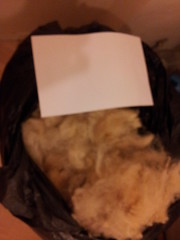
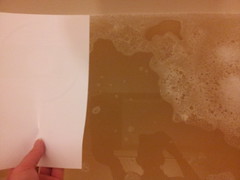
Here's the fleece:


The piece of paper is for contrast. The fleece is nominally white, but as you can see there are degrees of white. This is a pretty clean fleece. Minimal vegetable matter, hardly any dingleberries, no second cuts. It's still very yellow.


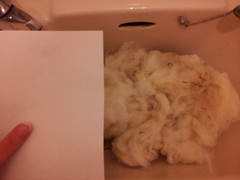
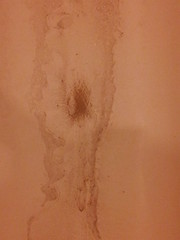
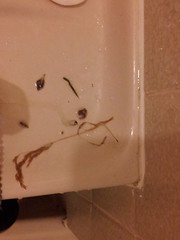
Not a huge difference, but there's already a clear difference after one wash with hot water and Fairy Liquid. This is the water after that rinse and the solid dirt left in the tub:


Urine, sweat, dirt, all kinds of delicious stuff. Also, this is what minimal vegetable matter looks like:


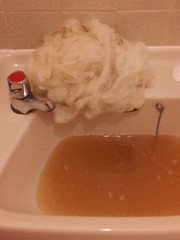
The second batch, just rinsed with cold water:


The water is less cloudy, which is what I'd expected since there's no melted lanolin in it. The fleece itself is still tacky to handle but is actually less discoloured than the stuff that's been washed with hot water and soapy liquid. The biggest difference is that the tips of the fleece haven't come clean - not a huge issue, since I'll be combing before I spin anyway.

Removing vegetable matter is about the same, and intriguingly the very few second cuts floated away in the cold rinse. They tend to stick in the hot wash. Also, rinsing in cold means having to be less careful about agitation - you need heat to full wool.

The side-by-side washed fleece:


Cold on the left, hot on the right. The dirty tips are visible, but you can see that they're visibly about as clean. Assuming that the tacky feeling isn't a problem when it comes to spinning, this has the potential to vastly speed up the processing.

Wednesday, 17 December 2014

Some things that are not shirts

I'm working on two more Tudor shirts (this time both for me). They're going to become a series of posts that give complete guidelines on how to make shirts, but in the meantime, I've finished a couple of smaller things.

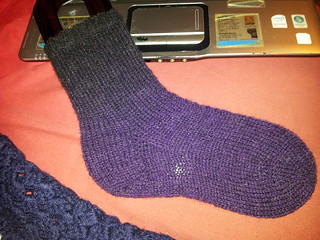
First up, a belt favour masquerading as a sock. Belt favours are a custom in the SCA - non-fighters give them to fighters as a token. Wearing them can mean a whole bunch of things, but literally means that the fighter has found favour with the non-fighter. In this case, it's a running joke with my "wife", who once caught a sock flung at her head and proclaimed herself a free house-elf.


Yarn is leftover Kauni from a shawl I made a few years back. This sock is a Very Significant Project. It's entirely made up from inside my head - I guesstimated all the numbers, including the ones for turning the heel. I also knit the whole of the gusset in the dark while I was at a gig. I definitely levelled up by knitting this.

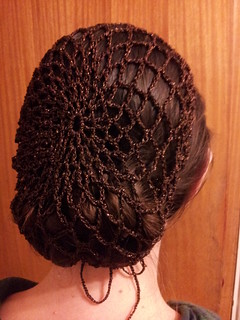
Second, a SNOOOOOOD for Tyger Friend. Like me, she dabbles in steampunkery, and so when I dug up some discontinued bronze lurex yarn from the deep stash it occurred to me that it would make an awesome gift for her. It took about 7 hours, or one very lazy weekend spent mostly playing Skyrim.

Wednesday, 3 December 2014

The second shirt, or, THE SHIRT OF INSANITY!

(This project was created as a surprise gift, so I've recorded everything as I went along in a single post. Now that it's been delivered, I can post this publicly.)

Having made one fairly straightforward shirt, I decided to dive immediately into the next one. I wanted to do something more complicated, and as it happened I had the perfect project in mind. This is what I did.

24 August

I've been planning to make something as a gift for Baron P., the guy who taught me to shoot last year and started me off on this whole saga of archery, late-period English clothing, and a million crazy research projects. (Come to think of it, I'm not entirely sure why I'm making him a present. But it's too late now.) I figure, all the hours he's put in answering my questions, he deserved something shiny. Coincidentally, he's recently been spiffing up his own garb and at Raglan was elevated to the Order of the Pelican. So instead of the embroidered collar and cuffs I'd originally thought I'd do, I decided that I'd go all out and make a complete shirt with fancy embroidery, frilled collar, the lot.

The first step was figuring out how I was going to construct the whole thing. I've been poring over Patterns of Fashion 4, looking at all the different shirts and how they were put together. Based on those, it looks like the most common method was a single long strip for the front and back, usually made from the full width of the cloth. Sleeves either straight with an underarm gusset or trapezoids without. The cool thing is that the pieces are usually hemmed all the way around and then joined with insertion embroidery rather than being seamed. So that's what I'm doing - a single piece of cloth for the body, straight sleeves with a gusset, and hems and insertions.

I spend the morning cutting out the pieces that get hemmed. The linen I've got is 54 inches wide, which is far too wide for a shirt. Consequently, I'll have a selvedge on one side and a hem on the other. There are examples of this in the book (items 2 and 5, in Munich and Prato respectively), so it's an acceptable option. I've cut the shirt body 30 inches wide, which leaves me with exactly the right amount of fabric to the side to be the full length of the sleeve, leaving the selvedge on the cuff end of the sleeve. I've cut both of them out as well. I then cut a strip 5 inches wide below the sleeves. Two 5-inch squares will become the underam gussets; the rest of the strip will be for me to practice the insertion stitches and test the embroidery. I may use a bit to make gussets for the neckline also.


My next task is to hem all the pieces I cut out. I've hemmed one gusset and one sleeve today. Once the hemming is done, I'll chart up the embroidery and start working on the sleeves. The gussets are small enough that I'll be able to take them in with me to work and do the stitching around the edge that becomes the foundation for the insertion.

26 August

I spent most of yesterday brainstorming the design for the sleeve embroidery. I knew I wanted to do columns and spot motifs like the Bath Fashion Museum shirt I used as a model for shirt the first, but beyond that I had no specific ideas. Those sleeves had three columns of densely stitched vines and flowers running down the length of the shirt. In between were isolated motifs of oak leaves and acorns, and bees. I didn't really want to do flowers again, and the acorns-and-bees thing would just be too similar to what I'd done for my husband. Fortunately, there was a very obvious choice for something to use as a spot motif - a pelican in her piety. I recalled that Patterns of Fashion had reproduced a number of motifs from Schole-House for the Needle (a pattern book published in 1632), and as it turned out, one of them was of a pelican. Serendipitously, on the same page was reproduced a springing stag, which just so happens to be on the Baron's coat of arms.

After an hour of sketching and rubbing out designs:


and a little trying things out with needle and thread:

I finally got to the point where I had a concept that I liked.


29 August

My self-imposed deadline for this project is an event taking place the last weekend of November. In other words, I've got just about three months to finish. Because I'm a crazy person, I decided to write up a list of all the bits that need to be done between now and then to get the shirt finished.

  • Finish hemming the second sleeve
  • Hem the body
  • Embroider both sleeves
  • Embroider the neck opening
  • Embroider the collar
  • Embroider both cuffs
  • Embroider and hem the frills for the collar and cuffs
  • Work the foundation for the insertions on the seams
  • Assemble the cuffs with frills and ties
  • Assemble the collar with frill and ties
  • Gather sleeves and attach cuffs
  • Cut and hem neck opening
  • Reinforce bottom of neck slit
  • Gather neck opening and attach collar
  • Lace the seams together.
I also need to decide whether I'm going to embroider around the edges of the body. Fortunately for my sanity, I don't need to make that decision until after everything but the seam lacing is done. I'd like to, both because most of the really fancy exemplars have and because it's awesome. At the same time, it's a lot of work to put in to something that's going to be tucked into trousers most of the time.

2 September

I've finished the hemming! (Ok, the frills still need to be done, but I can't do them until they're embroidered and cut out.) My brain has very kindly been providing me with inspiration and the ability to make decisions over the last couple of days, so things are progressing. I ended up deciding firmly in favour of embroidery all the way around the edges of the body and have started working on them while I wait for the Muse to decide whether she's happy with the modifications I've made to the initial embroidery sketches.

My very scientific method of deciding how many motifs I wanted on the sleeves - cutting out bits of paper roughly the same size as the motifs and laying them on the fabric until it suited me:


8 September

Mental progress, if not a great deal of physical progress. I have finished designing the embroidery. This is the design for the cuff:

The collar will be the same, only with more repeats of the lattice and flowers between the pelicans. The embroidery that borders the neck opening will be the same, only with the lattices running vertically and a single pelican at the base of the opening.

The sleeves will have a similar lattice, but it'll be narrower. Instead of 8-petalled flowers inside the diamonds formed by the lattice, the smaller 4-petalled flowers will appear. There will be three columns of lattices on each sleeve. In between the lattices there will be two columns of five spot motifs, each comprising alternating pelicans and stags (three and two of each, respectively). The frills will have individual 4-petalled flowers without the lattices.

All of the lattices are bordered by a straight double line. That double line is what I am using as the edge embroidery.

Now that the design decisions are mostly out of the way, it's time to crack on with the sewing. Today's mission is figuring out my cutting layout for the collar, cuffs, and frills. I enlisted the help of Baron P's lady wife to get his collar measurement, and I'm making it the same width as the previous shirt. Looking at different frills on extant shirts, they seem to range from 1.5 to 3 times as long as the band they are set in. My frill is going to be 35.5 inches long because that's the length of the piece of fabric I have left. I've decided to use the selvedge edge for the frill to save time hemming - this fabric has gorgeous selvedges, almost indistinguishable from the fabric proper, so it won't be obtrusive.

later on the 8th

No embroidery on the frills. I tried it, and it frankly looked like crap once it was all gathered up. Ah well, at least that's a few hours saved!

10 September

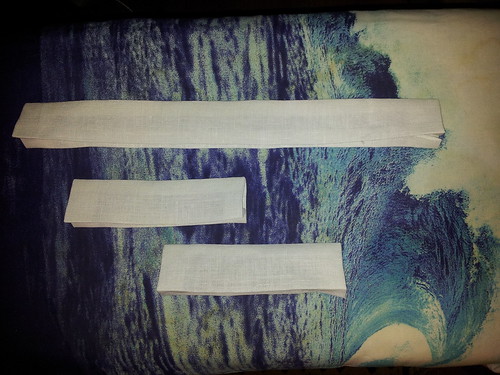
Some photos of my progress to date. The long strip at the bottom is the collar frill, now hemmed on the two short ends. The big pieces are the sleeves, and the two small squares are the underarm gussets. (Incidentally, several of the extant shirts I've been looking at have embroidered gussets. Seriously. Talk about conspicuous consumption!)

 I'm still beavering away at the embroidery on the body of the shirt over my lunch hours at work. It's utterly mindless, and the body is completely hemmed so I don't have to worry about it fraying from being hauled around.


The red basted lines are the shoulder "seam" and the neck slit. At least, they will be once I've cut them. I'm still trying to decide whether it would be better to cut the openings and hem the neck slit before or after I work the embroidery around the neckline.

25 September

Sigh. Things are never straightforward. That annoying niggling voice in the back of my head has been telling me that the style of embroidery I'm doing really doesn't match the style of shirt, and after doing rather a lot of thinking and research, I've concluded that the voice is right. (Also the voice didn't like the 8-petalled flowers I'd designed, so I've changed them.)

The problem is with the frills, or rather with the combination of frills plus embroidery. The style of embroidery is very firmly in the style of the 1590s, by which point frills on shirts had disappeared in favour of detached ruffs. Since there's no way in hell I'm redoing all that embroidery, I've decided to just skip the frills. Fortunately the plain straight cuffs and collar are appropriate to the embroidery...

26 September

Onwards and upwards. I eventually decided to do the neckline embroidery before cutting the opening, just because it meant I could keep carrying the shirt body around to work on. I still haven't finished the double-line edging, but it'll get there eventually.

I'm really glad I decided to do some extra measuring around the neckline before I started pencilling on the design. Not because I'd originally mismeasured, this time, but because there turned out to be a flaw in the fabric that would have been right in the middle of the embroidery! It's nothing that will affect the integrity of the shirt, but it would have looked pretty ugly. Unfortunately, that meant picking out and redoing all of the basting. (The shirt is longer in the back, so I couldn't just flip the neck opening to the other side. The shoulder "seam" had to be moved too.)

Transferring the design was made infinitely easier by my mother, who decided she was going to buy me a lightbox. Best surprise gift ever.
The templates came with the box. I'm not putting drumkits on the shirt!

I spent 10 minutes at a table instead of half an hour or more pressed against a window. I use a soft pencil for transferring designs, and only transfer a small portion of the design at a time so that the friction from working doesn't rub it off before I have a chance to embroider over it.

The finished neckline embroidery came out pretty well, I think:

There is, perhaps, too much white space surrounding the pelican, but I think it works. The same trellis-and-flowers appears on the cuffs and collar, and then the sleeves will have just the smaller flowers running down the length.
 

20 October

Now that the design decisions are all out of the way, there's less out-loud thinking to do here on the blog. I'm mostly just sewing. I'm a little behind where I wanted to be, but I'm making good progress. The neck and collar are completely finished, right down to sewing on the ties. This has the advantage of making it possible to put the body on a hanger and keep it safe and out of the way.

Gathering the neckline into the collar was significantly easier this time around, not to mention faster. Making the collar in two pieces is definitely the way to go. Although it means more time spent pressing, the extra layers of fabric and the seam along the top of the collar help stiffen it, which makes it hold its shape better.

In the further interests of better shape, I've added two pairs of ties to this collar. I had just one on originally, but when I tried wearing it the corners of the collar bent down and rendered the embroidery invisible. Having a pair of ties at the top of the collar should hopefully remedy that issue.

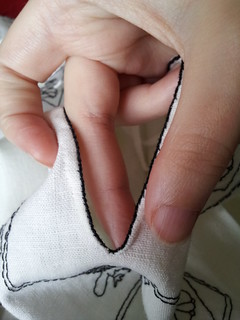
A detail I've added to the collar is a length of twisted cord. It's two strands of embroidery floss that I've couched down around the entire edge of the collar and the neck opening, using a single strand of floss. Most of the very late 16th-century shirts have narrow lace edgings around the collar and neck, but by that point the wide lace trims or frills had been replaced by separate ruffs. I don't have any appropriate narrow lace, nor the time to make any, but there's a shirt in the V&A that has both collar and cuffs trimmed with couched cord. Although that shirt is from the 1540s rather than the 1590s, I think it's a plausible treatment that could have been substituted for the narrow lace. I felt very strongly that the neckline needed something edging it, not for decoration but for reinforcement. The embroidery is too close to the hem to allow application of a reinforcing patch (deliberately close, I hasten to add!), but I don't want it to rip out with wear. The loop of cord will serve to strengthen it. Plus it really brings the whole thing together, in my not-so-humble opinion.


12 November

Racing to the finish now. Real life has delayed things a number of times, which is why I built an entire month of wiggle-room into my schedule! I've spent most of the last few weeks working the blanket-stitch edging around the completed pieces in between visits from my mother, archery practice, and helping out with my new niece. So, current status:
  • The body of the shirt is completely done, including putting the blanket-stitch edging all the way around.
  • The first sleeve and first gusset ditto.
  • The first sleeve and gusset have also been pressed and laced together, ready to go onto the shirt body once it's been pressed.
  • The second gusset is nearly finished. There's about an inch of backstitch left to do.
  • The second sleeve is in progress. I plan to have the last of the embroidery done by Friday evening.
I plan to spend the weekend attaching the second cuff, working the last of the blanket-stitch, and then lacing everything together. Once that's done, it'll just be a case of writing up the documentation and buying a nice box to put everything in. And trying not to go crazy from keeping it a secret...

16 November

It's done. Holy crap it's finally done.


17 November

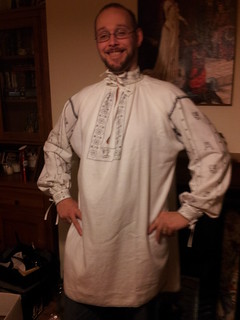
Now that my brain is functioning after the shock of being done, some numbers and a photo!
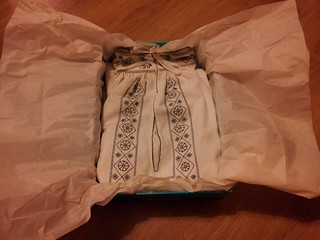

  • 19 pelicans
  • 8 stags
  • 26 large flowers
  • 124 small flowers
  • 9 hanks of embroidery floss
  • 35,000 stitches (approximately)
  • 475 hours of work (approximately)

26 November

I've given the shirt to Master P. It fits, and judging by his reaction I'd say he likes it!