Monday, 14 November 2016

The next thing

There's always a "next thing". In this case, it's a mostly-needlework project that I'm hoping will be completed by the end of next July in time for our major SCA camping trip.

Among attendees there's a tendency to have more and more stuff every year. There are some who have so much in the way of equipment and furniture that they have to hire a van to get it all there. That's absolutely fine if you can manage it, and if I'm perfectly honest I'd love to do that myself. For lots of reasons (starting with no driving license and ending with very little storage space) I can't, however. So, this year, instead of wrestling with the limits of a small flat and public transport, I've decided to embrace it and have a completely different Raglan experience.

Instead of channelling my inner noblewoman, with her baggage train, servants, and travelling bed, I'm going to try channelling someone from a lower walk of life - a merchant. I could still travel, but instead of bringing my accomodation with me I'd be relying on inns. And as for baggage, I'd be limited to what I could carry myself (or get a packhorse). That being the case:


I did a little shopping at the re-enactors' market this weekend!

My new basket looks smaller than it actually is - it's the full length of my torso and a bit larger around. The plan is to take only the personal equipment that I can carry in the basket or wear on my body. Well, that plus my longbow, of course. I'll also have the tent and camping bed I share with my spouse serving as a substitute inn.

As for the specifics of what goes in the basket... Well, that's where the needlework comes in. Most of the clothing I own is rather bulky, or comes from a time and/or place where I can't prove the use of such baskets for transporting goods. That being the case I'm planning to put together a new wardrobe, because why wouldn't I?!

I'm working entirely from Bodleian Library MS. Bodl. 264, which is an illuminated version of the Romance of Alexander originating in France from between 1338 and 1344. It contains a vast number of illustrations, and is rather unusual because it shows both lower class people (in the marginal decorations) and the nobility (in the body of the text), giving a much better idea of how clothing changed at that time and place according to rank.

The plan is to have around 5 linen shifts, three or four linen underdresses, and two or three wool overdresses. Additionally, I'll need veils, hose, a belt, shoes, and things like a bowl and an eating knife. Collectively it shouldn't take up more than a third of the basket, which will leave space for extra things like my quiver and arrows.

Monday, 7 November 2016

Constanza's chocolate science, as served at Raglan Fair XII

This article previously appeared in the September issue of the Baelfyr.

In the lead-up to Raglan Fair, I took part in an online course called A History of Royal Food and Feasting, put together by the University of Reading and the Historic Royal Palaces. One of the sections was on drinking chocolate, primarily during the reign of George I, but also included earlier history of this luxury food.

A major component of the course was practical work making the foods (and drinks!) discussed. One of the ones that particularly interested me was a recipe for chocolate wine by John Nott from his Cook’s Dictionary of 1726. This recipe was described as indicative of chocolate wine recipes. I didn't have time to make it before I left (and foolishly forgot to write down the recipe), so my version was an approximation. Still, it tasted good, and the proportions were nearly right! 

Original recipe:
Take a pint of sherry, or a pint and a half of red port, four ounces and a half of chocolate, six ounces of fine sugar, and half an ounce
of white starch, or fine flour; mix, dissolve, and boil all these as before. But, if your chocolate be with sugar, take double the quantity of chocolate, and half the quantity of sugar; and so in all.

My attempt (For Science!)

Ingredients:
4 100g bars of 85% cocoa solids plain chocolate (Course notes stated that it was important to use chocolate of at least 80% cocoa solids. Mine came from Tesco; Hotel Chocolat sell 100% bars.)
1 bottle of decent port
4 tablespoons of white sugar (approximately - I poured it in and tasted it until it stopped being so bitter I couldn't drink it)
Pinch of cinnamon
Pinch of ginger (I honestly don't know where I got the idea that there were meant to be spices in it, but put them in I did.)

Dissolve the chocolate over a low heat, stirring with a whisk. You could use a bain marie, but it worked perfectly well in a saucepan over a gas ring. Once the chocolate is completely dissolved, slowly add the port, stirring constantly. Keep stirring until the chocolate and port have combined smoothly. Add the sugar and spices. Pour into a jug and serve hot.

Sunday, 9 October 2016

Overdue

Back when Boss Laurel and I set up this apprenticeship malarkey, there were terms and conditions. One of the things I had to do was make myself an apprentice belt. (Context for the non-SCA readers - there's a tradition within the Society that apprentices wear belts, usually green, to mark their status. Frequently the belt is a gift from the Laurel to the apprentice, but not always.)

The belt didn't have to be green, in my case, but I had to make it myself. And when I say "make it myself", I mean I had to do all the steps the craftsperson would have done in the Middle Ages. So, had I made a leather belt, I could have bought a metal buckle, but I'd probably have had to tan my own leather.

The mission was further complicated by two things. One - I don't like wearing belts. Two - I already have two green apprentice belts, both of which were gifts from dear friends and are what I wear all the time. So whatever I made needed to be not at all belt-like and also not duplicate the function of either of the others I already own.

I put the whole thing on the back burner, mostly to give myself time to mull it over and figure out what I'd actually wear. Then the 16th century happened and I basically made myself a new court outfit in the style of the English 1540s. What I never did get around to making for it was a jewelled girdle, because jewelry-making is WAY outside my comfort zone. Also, it's expensive, and it's hard to find table-cut gemstones.

Then I came across this portrait and found another option:
Copyright the Royal Collection
Specifically, this bit of it:
Looking at it closely, it's essentially a string of pearls with a chain and medallion hanging off the front. Even I can manage that!

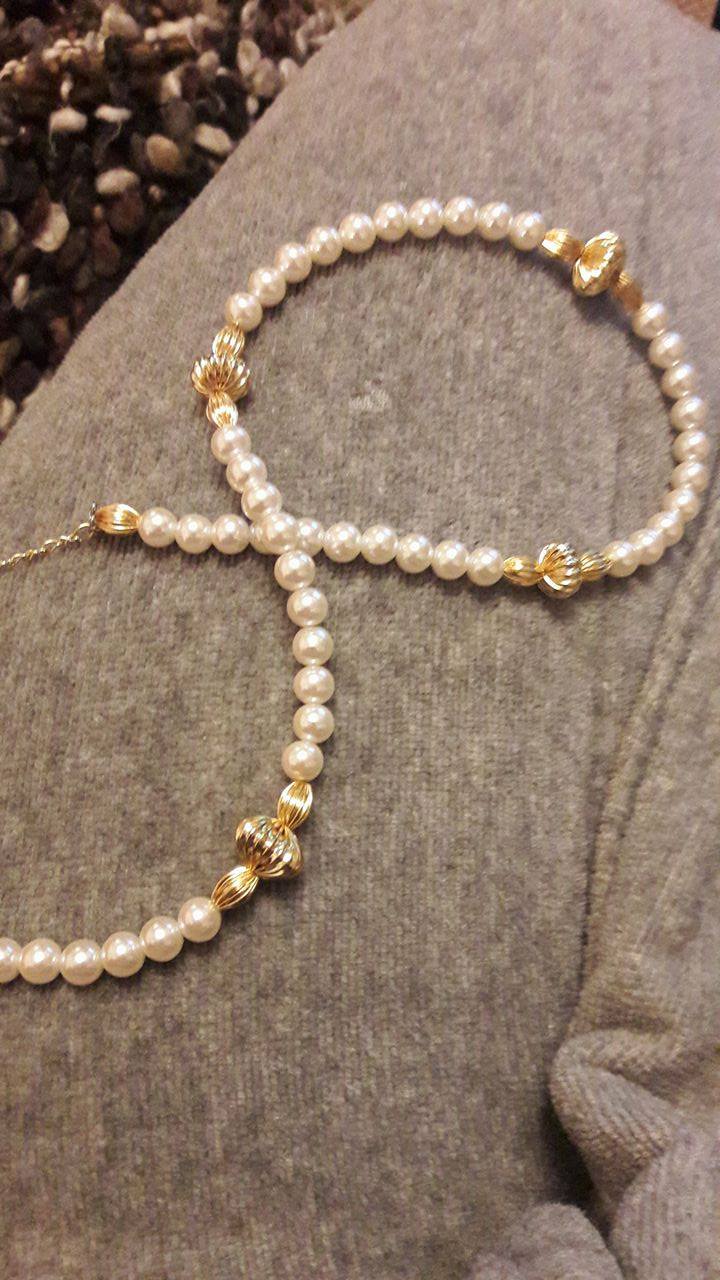
I set off to my favourite crack dealer needlework supply shop and came home with an assortment of artificial pearls, gold beads, and gold chain. I had considered threading all of it on silk, but I want this to be sturdy enough to survive more than one event, so I decided to buy tiger tail. The nylon component is modern, but jewelry on wire is accurate.

Once I got home, I spent mumble-mumble hours with a bead reamer smoothing the insides of the beads. Again, this is for long-term survival of the girdle - any sharp edges run the risk of wearing through the wire.

There's no clasp visible in the painting, but it has to fasten somehow. I've used a hook and eye and put them at the front of the pearl strand - it'll be easier to put the girdle on, and it means I can use the hook to attach the chain and pendant.

I've used the gold beads to space out the pearls because the shop didn't have enough pearls in the right size to fit my waist.

The pendant is a silver and garnet Christmas decoration my mother bought me in Istanbul years ago. It needs a good polish, but it's pretty and does a good impression of the pomander pendants on many of the girdles shown in portraits.

And finally, the finished girdle.

Photos with the full outfit next month - it takes nearly an hour to get into it, and I need assistance from someone better with hoopskirts than my spouse!

Saturday, 1 October 2016

Exhibition review - Opus Anglicanum at the V&A

Yesterday evening I went to the members' preview of the new Opus Anglicanum exhibition at the V&A, courtesy of my lovely colleague. It was, in a word, amazing. No photos allowed, sadly, so this will have to be words only.

The exhibition itself fills about five rooms of the museum's flexible exhibition space. It comprises 83 objects, mostly embroideries, but also a nice range of stained glass, needlework tools, tiles, and brass rubbings (among other things!). The objects are nicely spaced out, so there's plenty of room to look around. Also, many of the cases are glass on both sides so you can see all the way around the objects. The signage and labelling is also really good, plenty of information about the thread AND the ground fabric, including notes about the weave structure. There was one button I wanted to know more about, but that was the only problem.

The embroideries themselves are mostly ecclesiastical, but there are also pieces from court inventories as well as fragments too small to identify. They span about 350 years, with most of the collection dating from the 13th and 14th centuries. In addition to the more usual gold-and-silk on linen, there are also examples of some more unusual things, including a seal bag that is the only known extant piece of medieval English wool inlaid work (on loan from Westminster Abbey, no webpage available), and a chasuble which is the earliest known example of kanzi fabric in England. (Kanzi is an Iranian blend with a silk warp and cotton weft.) The objects on display are from a number of collections outside the V&A, including the British Library and the National Museum of Iceland, among others.

The lighting is low for preservation purposes, and as mentioned above there was no photography permitted. Plan to bring a sketchbook if you're not going to get the catalogue.

Speaking of the catalogue, it's 310 pages of hardcover, full-colour yumminess, well worth the £35 price tag. It weighs nearly 2kg, but it was definitely worth hauling home. In addition to the full catalogue, there are also eight essays detailing the context of Opus Anglicanum, its methods of work, the materials used, and the relationship between the English embroidery industry and the rest of Europe. There's a full glossary and an extensive bibliography. Additionally, each catalogue entry has its own set of citations where the object has previously been studied.

In summary, I'll paraphrase my excited Facebook post from last night:

If you are interested in historic embroidery. If you are interested in historic textiles generally. If you are interested in any sort of embroidery. If you are interested in heraldic display. If you are interested in 13th-century trade networks. If you are interested in ceremonial clothing. If you are interested in the relationship between medieval embroidery design and its contemporary artworks. GO.

Monday, 5 September 2016

In which I muse on curtains and growing up

I grew up in a home filled with handmade textiles. My mother made most of the soft furnishings, everything from blankets to tablecloths to embroidered guest hand towels. And that doesn't even cover the decorative things like tapestry cushions and Christmas tree ornaments. It was (and is) cozy in my mother's home, soft and warm and welcoming.

Inevitably, I started to do the same with my own home when I moved out. It's a very different style, to be sure, but I have handmade blankets on the bed and crocheted cushions on the sofa, along with lace snowflakes on the Christmas tree and samplers on the wall. "It's what grown-ups do," says the little voice in the back of my head.

The one thing I had never done was make my own curtains. That's Mom's thing. Actual curtains to keep in the warmth at night and sheers for privacy's sake during the day. I had never needed them, but the Spouse and I recently moved into a ground-floor flat that faces the road. It was a choice between making sheers or never opening the blinds.

Mom came through with a set of surplus sheers from her previous house that didn't fit her new windows, along with the leftover fabric in case I needed to make more. Good thing, too: the picture window in our bedroom took two curtains, so we were one short.

I had planned to leave the existing curtains as they were, but they were longer than the window openings and were driving me potty. So I spent the afternoon hemming the existing four and making one all by myself.

It's such a strange thing, really, but I had been terribly intimidated at the thought of making my own curtains. I don't know why - it's not like I've never hemmed interminable rectangles of fabric before. But somehow this was a much bigger deal than making garb or knitting socks. Maybe it was because Mom hasn't made any curtains since I left home, at least not that I've watched her make. All my memories of the process are from before I really started sewing properly.

I feel like I've levelled up or gotten bonus adulting points or something. Clearly it's time to have ice cream for supper.


Tuesday, 16 August 2016

I don't even have a real excuse.

Life has been busy. Crazy busy. Running a ten-day SCA event for 150+ people on the other side of the country busy. I've been making stuff, but haven't really been up to posting much.

However, all this is behind me! The event is over! No-one died and the castle is still standing! I can make stuff again!

Things I am currently working on:

Yet another 16th-century shirt. This was one I bartered for some fencing armour and it's long overdue. Collar and cuffs embroidered, plain everything else.


A complete maintenance overhaul of all our garb and other bits. This is ongoing, but I've gotten a lot done, including darning some hose, reinforcing a bunch of seams, attaching trim, and regluing the soles of shoes. Most of what's left is finishing inside seams, but I have a pair of sleeves that need to be finished, too.

A crocheted Thing. Might be a shawl. Might be a blanket. I have no idea how big it's going to be when all the yarn has been used up, but it's mindless and good for my commute. (Oh yeah, I have a train commute now. We moved back in January.)

There are some major repairs pending on Spouse's wool coat after it got trapped in the suitcase wheels and dragged along the pavement earlier this year. Fortunately Mother Mine had leftovers of the fabric...

Saturday, 19 September 2015

Whoosh!

That was the sound of July, August, and most of September whizzing past me. Sorry about that. Things have been pretty hectic in Fiendishland. Raglan happened at the beginning of August. It was fabulous and stressful - fabulous for seeing people and doing things, stressful because I was helping to run it and we had a food co-op this year. Anyway.

New Frock 1.0 was successfully finished, and I am rather happy with it.


There is a fair amount of tweaking and adjusting that needs to happen for New Frock 2.0, but this is a functional garment that is comfortable. Also visible here is the velvet sash I made to go with it. Could probably have done with a longer one, but I might have gone mad if I'd had to sew it for a moment longer.

For bonus points, the lacing rings as I was attaching them:

I also made an overdress to go with both this version and the silk one, once it's done. The overdress is reproduction 16th-century fabric, so a little later than the style of the dress, but I love it utterly.

The pattern on the fabric was perfectly centred, so I was able to use it as a cutting guideline. Consequently, it lines up really well.

Here's a picture of the combo, taken at Raglan by my friend Ian Walden. (Photo used with permission.) I still need sleeves, a partlet, and a proper cap, but I'm pretty happy with how it came out!