(Normal people spend New Year's Eve washing fleece, right?)
The thing about sheep is, they're animals. They eat, they poo, they sweat, they step in stuff, they roll in stuff. When the fleece comes off it's pretty gross and needs to be washed before anyone plays with it.
There are a million ways to get the crap out of a fleece, both literally and figuratively. The two main schools are hot-water-and-dish-soap and fermented suint. Since I live in 3rd-floor apartment in central London, I generally use the former. Fill the bath with hot water and Fairy Liquid, swish around, drain, rewash if the water's really gross, then rinse and air-dry. I think my neighbours might complain if I started leaving buckets of fleece out in the communal garden.
I've been thinking a lot recently about whether this method in any way resembles the way people in the Middle Ages washed fleece, and my gut is telling me no. (Obviously I'm going to have to confirm this with research and documentation, but hear me out.)
- The hot-water-and-soap method is really time-consuming, and I've got access to a hot water system that doesn't rely on chopping firewood and hauling buckets to make it go. It takes me about 6 hours of actual work per fleece to process, and that's not including drying time. If I had a whole flock and had to process all of the fleeces every single year AND comb and spin them AND weave (or otherwise clothify) all of them in order to have a new piece of clothing, I wouldn't want to waste so much time.
- Firewood is expensive, either in terms of labour or in terms of money. Ditto soap. I go through about a quarter of an economy-sized bottle of the stuff per fleece, and it's concentrated.
- Hot water melts the lanolin and soap does an excellent job of removing it. But lanolin is what makes wool waterproof, so if my goal was warm clothing that would survive all weathers, I wouldn't want to wash the lanolin out.
- The fleece-to-garment process involves multiple stages of wet treatment, any of which could involve a hot soap wash.
So what my method does is take time and money to get an end result that isn't fit for purpose. That's not very helpful.
Access to water in the Middle Ages was primarily via surface water - rivers, lakes, ponds, things like that. There aren't any of those close to me, but I do have a cold tap and a bathtub. And I'm terribly fond of Scientific Experiments. Consequently, I'm going to do part of my current batch with my usual method and part with just a cold water "wash" and see how the results compare.
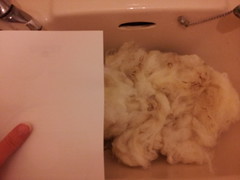
Here's the fleece:
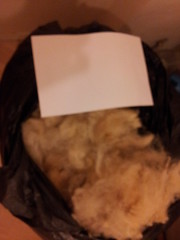
The piece of paper is for contrast. The fleece is nominally white, but as you can see there are degrees of white. This is a pretty clean fleece. Minimal vegetable matter, hardly any dingleberries, no second cuts. It's still very yellow.
Not a huge difference, but there's already a clear difference after one wash with hot water and Fairy Liquid. This is the water after that rinse and the solid dirt left in the tub:
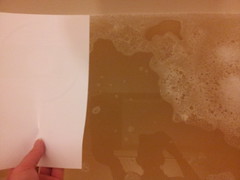
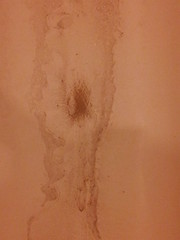
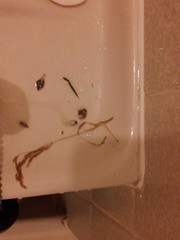
Urine, sweat, dirt, all kinds of delicious stuff. Also, this is what minimal vegetable matter looks like:
The second batch, just rinsed with cold water:
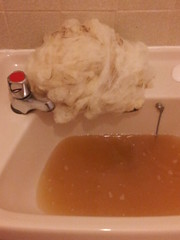
The water is less cloudy, which is what I'd expected since there's no melted lanolin in it. The fleece itself is still tacky to handle but is actually less discoloured than the stuff that's been washed with hot water and soapy liquid. The biggest difference is that the tips of the fleece haven't come clean - not a huge issue, since I'll be combing before I spin anyway.
Removing vegetable matter is about the same, and intriguingly the very few second cuts floated away in the cold rinse. They tend to stick in the hot wash. Also, rinsing in cold means having to be less careful about agitation - you need heat to full wool.
The side-by-side washed fleece:
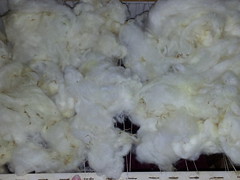
Cold on the left, hot on the right. The dirty tips are visible, but you can see that they're visibly about as clean. Assuming that the tacky feeling isn't a problem when it comes to spinning, this has the potential to vastly speed up the processing.