Showing posts with label SCA cookery. Show all posts

Thursday, 4 June 2015

Sossidges*

The event of cookery went well - the food was served at the right temperatures and on time, everyone seemed happy with it, and we hit the sweet spot of just enough leftovers that people had clearly eaten their fill but not so much there was a ton of wasted food. And the best part was that we in the kitchen actually had fun and got to participate in some of the other activities.

Rather than write up the whole feast as a single massive post, I'm going to do it one dish at a time. First up, fried sausages!

This is a slightly tweaked version of Peter Brears' sausage recipe (2015, p. 356), which is itself an amalgamation of three 17th-century recipes. I've increased the amount of black pepper, because I find that fatty sausages cooked in their own fat need the extra bite not to tasty greasy and gross.

  • 1 kg lean pork
  • 0.5 kg pork fat
  • 1 tsp ground mace
  • 1 tsp ground cloves
  • 1 rounded tsp ground black pepper
  • 2 tsp salt
  • 4 tsp dried sage
Coarsely grind the pork and the fat together through a meat grinder**. Grind all the seasonings together with a mortar and pestle until they are well mixed and of the same size. Pour over the ground meat and run through the grinder again to combine.

Brears recommends rolling the sausage meat out into logs if one isn't using casings, but in order to fit more into the frying pans I rolled them into balls instead.

Fry the sausages over a medium heat until they are cooked through and nicely browned. I didn't add any extra fat to the frying pan, as without casings some of the fat from the meat inevitably renders out.

Yield: about 100 walnut-sized sausage balls.

These may well be the tastiest sausages I've ever eaten, and as my mother used to make her own, I've tried a lot of different kinds.

*A Pratchett-ism that has slipped into the family lexicon.
**You could of course just mince the meat by hand, but if there's a meat grinder to hand I'd use that. It's faster. Alternatively, go find a nice butcher, give them your spice blend, and ask them to grind up the meat in the right ratio with the spices.

Sunday, 24 May 2015

Experimental biscuitry

I am at the tail end of preparing for the event of cookery and I've just one recipe left to test. It's for the nibbly dessert biscuits, and is the only recipe I'm redacting from the original myself.

Take a quart of life Hony, and set it upon the fire and when it seetheth scum it clean, and then put in a certaine of fine Biskets well serced, and some pouder of Cloves, some Ginger, and powder of sinamon, Annis seeds and some Sugar, and let all these be well stirred upon the fire, til it be as thicke as you thinke needfull, and for the paste for them take Flower as finelye dressed as may be, and a good peece of sweet Butter, and woorke all these same well togither, and not knead it. 

(Originally published in 1584.)

I'm interpreting that as:

  • Boil and skim a quart of honey
  • Add biscuit crumbs
  • Add ground cloves, ginger, ground cinnamon, aniseed, and sugar
  • Cook until thickened
  • Make pastry out of flour and butter
Since you wouldn't eat flour and butter paste, I assume one would then roll out the pastry, fill it with the cooked honey mixture and bake the resulting nibbles until they're done.

There is no leavening agent in this recipe, so the resulting biscuits are going to be very dense. It's almost going to be a spiced candy paste wrapped in pastry. Hopefully it'll taste good!

The ingredients are almost identical to those for lebkuchen, and I have a good recipe for those to indicate proportions.

For the trial batch:

  • 1/2 cup of honey
  • 1/3 cup of sugar
  • 1/2 tsp each of the spices
  • 1/3 cup of crushed Digestive biscuits.
  • Regular pastry, including water to hold it together.
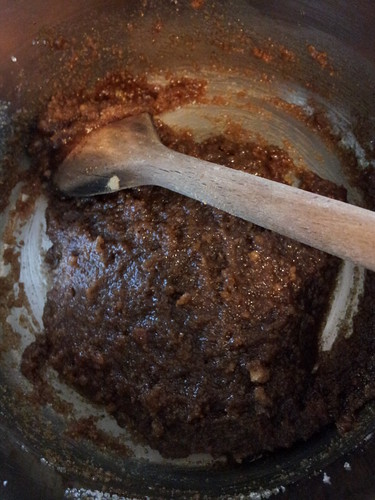
I warmed everything over the lowest heat on my cooker top. It being commercially-available honey, there wasn't much scum to remove, so the cooking went quickly. I added the sugar last, at which point it thickened up really quickly. And once it came off the heat it started to solidify almost immediately. On the day I'll need to make and roll all the pastry in advance so that I can assemble them before the filling gets too hard to work with.


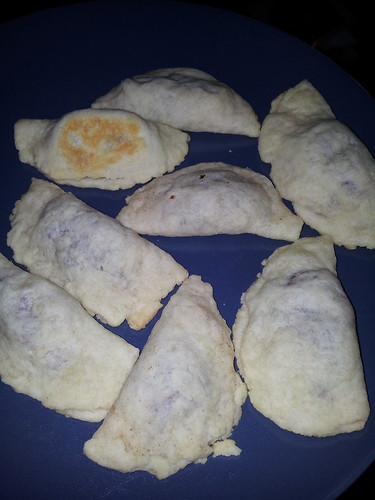
They need 10 minutes at 400F/Gas7 to cook the pastry. The filling reliquified on cooking, but I think I overcooked the filling. It really ought to have stayed soft. The ones I tasted fresh from the oven are delicious, though! The trick is going to be making sure I stick with soft ball temperatures.

Sunday, 29 March 2015

And they'll feast, feast, feast, feast!

Remember that medieval Arabic lunch I cooked last year? Well, I'm cooking for that event again this year. Only this year I'm not coordinating lunch. This year, Lady Co-Boss and I are between us coordinating the food for the whole weekend. Cue panic because the event's in 9 weeks and I need to test ALL THE RECIPES. (Well. Not the ones for Saturday lunch because I'm just repeating last year's.)

Conveniently, I have acquired a number of new cookbooks that I've been meaning to test. To that end I have begun planning! We've divided the meals for the weekend between us and invited two other attendees to deal with breakfasts. We'll share Friday night supper and Monday morning breakfast; I'm responsible for lunch and feast on Saturday while she'll be doing feast and supper on Sunday. Should work well. At least we won't be under one another's feet.

Lunch is going to be a repeat of last year's lunch. It was fun to cook and everyone seemed to enjoy it. The only thing I'm planning to change is making more flatbread.

The feast is going to be a little more complicated. The general sense of what makes a feast is that it should have a wider range of dishes and be presented beautifully, as well as possibly involving some sort of entertainment between courses. The entertainment is not my job, but I think I can handle the rest. I've decided on a Tudor feast, both because of the 1545 project and because I've a cookbook with redacted versions of Tudor recipes to work from. (Redactions being interpretations with amounts written in, they are much easier to cook from than recipes that call for "enough flour to make the dough".) The chap who's done the redactions is also the person who coordinates the food in the Tudor kitchen at Hampton Court, so while I'd eventually like to do my own redacting, I'm confident that his are a reasonably accurate starting point.

My personal preference is to have each course be roughly half meat and half vegetables or fruit, plus bread. After trawling through the cookbook, what I'm thinking at the moment is this for the first course:

  • a compound salad (greens, fruit, pickled things, flowers)
  • lamb stewed in beer
  • fried pork sausages
  • strawberry tart
For the second course:

  • beans fried in butter
  • meatball pears (not sure what meat yet)
  • cabbage cooked in stock
  • chicken and bacon pie
Currently there aren't any vegetarians booked. If any do come, I'll add individual alternative protein dishes of some sort to the first course and do some of the cabbage in vegetable stock. I've tried to minimize the number of dishes that use the oven, since the one onsite is notoriously fickle.

This evening I'm testing the lamb in beer. Recipe comes originally from a cookbook dated 1557. The recipe calls for a leg of mutton from which one removes the meat and slices it into thin strips. Since I'm not going to have any use for a bone I've gotten chunks, and since most people prefer it I've gotten lamb.
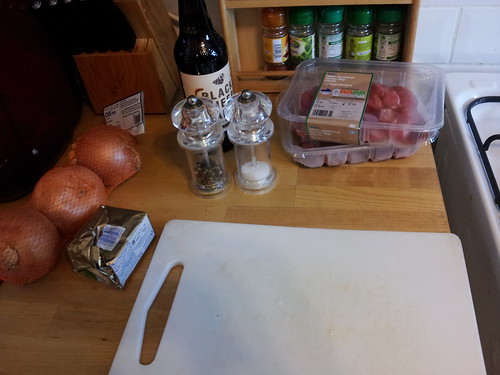


Basically, you throw the lamb, a sliced large onion, and a bottle of brown ale into a pot.
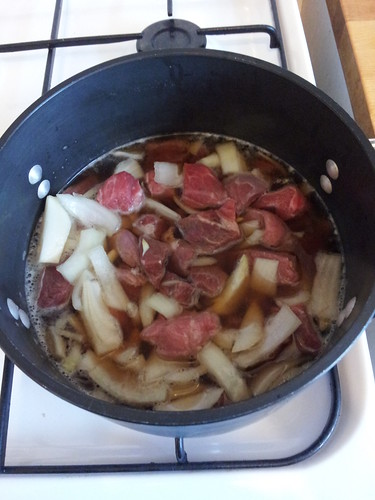


Simmer it for an hour, then throw in a knob of butter and some salt and pepper before simmering for another 20-30 minutes.
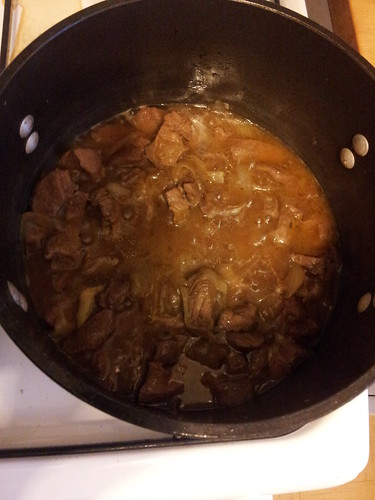


The lamb is fork-tender and flavourful. A bit bitter, though, so I'll need to pick a different beer. (Fantasy project - making the recipe with beer brewed from a 16th-century recipe.) The beer boiled over if looked at funny, so it'll need careful watching. Otherwise, complete success, definitely on the menu. 

Also testing out the filling for a strawberry tart. Recipe from 1665, but similar recipes appear in earlier cookbooks. I'm not worried about the pastry, so for today I was lazy and bought a prebaked shortbread crust. The tart filling is strawberries, red wine, cinnamon, ginger, and sugar.
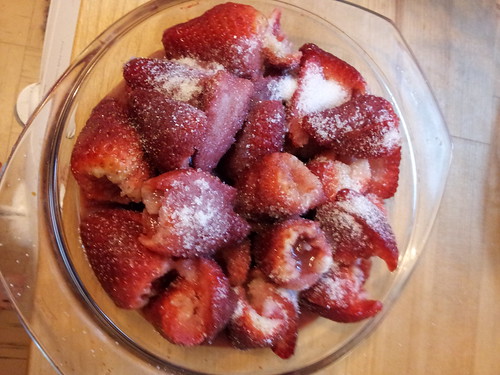


You're supposed to arrange everything artfully in the pastry case and then bake it for half an hour, but I've just baked the filling separately and poured it over the crust for tonight's dessert.
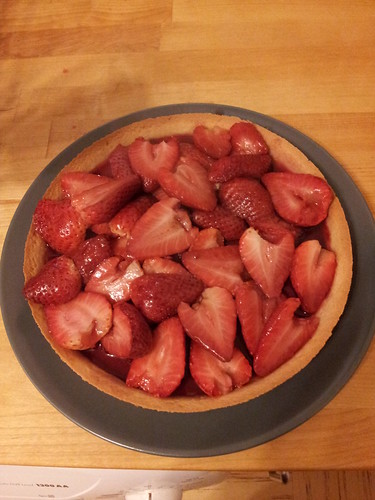


Verdict - omnomnomnom. This is probably going to be added to the regular dessert rotation.